One move, and a board that punishes haste
Peg Solitaire has a single rule: a peg jumps over a neighbour into the empty hole beyond, and the neighbour comes off. Every jump removes exactly one peg, so a layout of thirty-two pegs is always thirty-one jumps, no more and no fewer. What changes is whether those jumps are still available when you need them.
The board is unforgiving in one specific way. A peg can only move if another peg sits right beside it with an empty hole on the far side, and a peg can only be removed if something jumps over it. So a peg that ends up with no neighbours is stranded for good. Most lost rounds are not lost at the end; they are lost ten jumps earlier, when a peg was left on its own in a corner of the cross.
Start with the small layouts
Cross and Plus are there to teach the feel of the move. Only one or two pegs can jump at the start, so you learn to look for the shape of a legal jump: peg, peg, hole, in a straight line. Try to finish each of them in the centre before moving on; a centre finish on Cross takes a little thought, and that thought is the whole game in miniature.
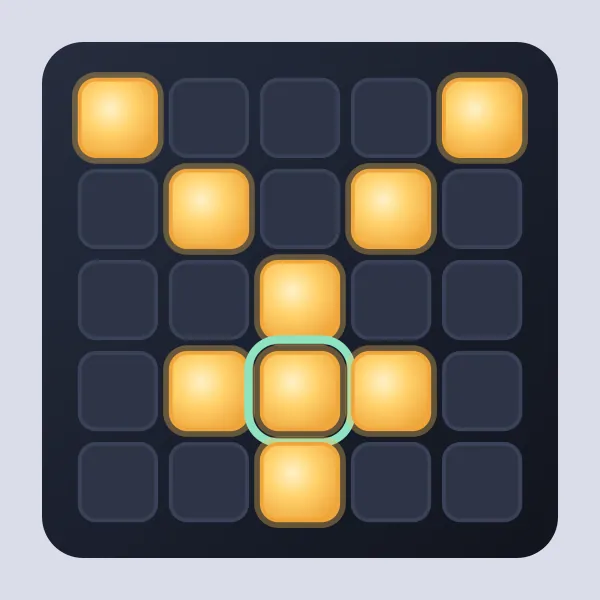
Fireplace and Pyramid introduce the real skill, which is clearing a block of pegs from one side without leaving one behind. A row of three pegs with holes beyond both ends can be cleared by jumping the outer pegs inward over the middle, and that pattern, in all four directions, is what most of a solution is made of.
Think in groups, not single jumps
Experienced players do not plan thirty-one jumps. They plan a handful of clearances, each of which removes a small block of pegs with a short, repeatable sequence, and they leave one peg in a known place when each block is done. The two worth learning first:
- The three-in-a-row. Three pegs in a line with a hole at one end: the end peg jumps over the middle, then the remaining peg jumps back over it. Two jumps, two pegs gone, one left where you chose.
- The six-block. A two-by-three rectangle of pegs beside a free hole can be cleared to a single peg in a few jumps if you work from the outside in. Set these up on Pyramid's bottom row and you will see the shape.
Between clearances, keep one eye on the pegs far from the action. The arms of the cross are the usual trouble spots, because a peg left at the end of an arm can only be reached by a jump along that arm, and it is easy to clear the arm from the wrong end and lose the way back.
Working toward the centre
Finishing in the centre hole is the traditional win, and it is worth aiming for. The trick is to plan the last two or three jumps first. Think about which pegs could be left at the end and where they would have to sit for a final jump to land on the centre: two pegs in a line with the centre as the empty hole beyond them. Then clear everything else while keeping those pegs out of the way.
If you only need a one-peg finish, any lone peg will do, and the puzzle is noticeably easier. Clear the board freely and let the last jump land where it lands.
Reading a stuck board
When no peg can jump, look at what went wrong before you start again:
- Pegs on opposite sides. Two pegs with empty space between them can never meet. The order of your clearances split the board in two.
- A peg in a corner of the cross. The ends of the arms have only one neighbour direction. If that neighbour was removed early, the end peg was stranded.
- A pair with nothing to jump into. Two pegs side by side with pegs or the board's edge on both far sides. One of them needed an empty hole first.
Undo steps back one jump at a time, so you can rewind to the moment the board split and try a different order. Hint picks up a peg and rings a hole for it; it is only offered when a one-peg finish is still possible, so if the button does nothing, the position is already lost and Undo is the way out.
Moving through the layouts
Work up in order. Cross, Plus and Fireplace can each be solved in a few minutes once you see the three-in-a-row. Pyramid and Arrow are where you learn to clear blocks. Diamond is nearly the full board and a good place to practise planning the ending. The Full board, with every hole filled but the centre, is the classic puzzle, and a centre finish on it is a genuine achievement: there are many ways to leave one peg, but far fewer to leave it in the middle.
Your record for each layout shows how many rounds you have solved, how many ended in the centre, and the fewest pegs you have ever been left with. A good long-term goal is a centre finish on every layout without a hint.